June 23, 2026
With rising cases of measles being reported nationally and here in Oregon, the Oregon Pediatric Society (OPS) has partnered with the American Academy of Pediatrics (AAP) and Judy Guzman-Cottrill, DO to bring timely, practical information about measles and related infection prevention education to pediatric providers and medical clinic staff across the state.
Meet Dr. Judy Guzman-Cottrill

Dr. Guzman-Cottrill is a Professor of Pediatrics in the Division of Infectious Diseases at Oregon Health and Science University and Doernbecher Children’s Hospital. She also serves as the Medical Director of Oregon Health Authority’s Oregon Project Firstline, an infection control education initiative for health care workers. In addition, she owns an independent consultancy focused on the fields of health care epidemiology and infection prevention. She is board-certified in both pediatric infectious diseases and pediatrics, with more than 22 years of experience caring for some of the most medically complex children in the region.
In these roles, Dr. Guzman-Cottrill has worked with state government to shape policy and response, consulted with pediatric providers around Oregon on infection control measures, and co-managed complex patient cases at Doernbecher Children’s Hospital. She also directs the Pediatric HIV Program at Doernbecher. Her career has spanned some of the most consequential infectious disease challenges of our time, including HIV, ebola, COVID-19, and now, the resurgence of measles.
Commitment to OPS and the Community
As a long-time member of OPS, Dr. Guzman-Cottrill has taken on leadership roles within the organization, including serving as a trainer for the Suicide Prevention for Medical Providers (formerly Youth SAVE) program. Her commitment to the pediatric community extends well beyond the clinic — she has contributed to national guidelines and research on infection prevention in pediatric settings, COVID-19 outcomes in children, and many other topics. From 2019-2023, Dr. Guzman-Cottrill served as a member of the CDC Healthcare Infection Control Practices Advisory Committee (HICPAC). When she’s not working, Dr. Guzman-Cottrill finds joy in live music, attending concerts and shows in Portland and around the country. She has also said that what keeps her energized in her clinical work is the patients themselves: “They are always optimistic and so resilient. I am always amazed by how even my sickest patients have the ability to heal.”
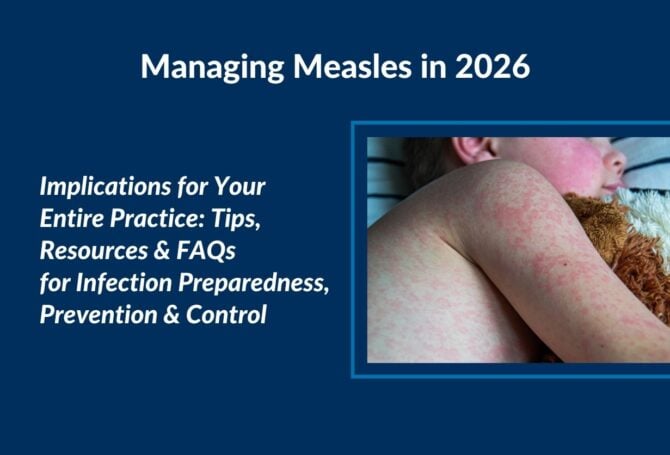
In April 2026, Dr. Guzman-Cottrill teamed up with OPS to deliver a training entitled “Managing Measles in 2026,” available to the general OPS membership and providers statewide, as well as to large, multi-role groups from OPS Practice Partners. The sessions covered the following learning objectives:
- Recognizing the key signs and symptoms of measles disease
- Knowing what resources are available when managing a patient with measles disease or exposure
- Understanding strategies to decrease the spread of measles virus in your facility
- Understanding the concept of syndromic surveillance.
Measles Questions & Answers
Click here for a PDF of the Q&A.
Session attendees had many great questions, which Dr. Guzman-Cottrill has kindly answered below. We are sharing this information to help strengthen our public health systems across Oregon and encourage you to pass these insights along to other pediatric health care providers in your network.
Question: Is it recommended for all staff to get MMR titers to ensure immunity, or just ask about two vaccines? What steps are recommended?
Answer: If you were born before 1957, you likely had measles as a child and have lifelong immunity. If you received two doses of MMR vaccine in your lifetime, you are considered immune and measles titers are not routinely recommended. Some health care employers require titers as a condition of employment, but this is not a standard recommendation for individuals. If you are unsure about your MMR vaccination history, it is safe and recommended to get an MMR vaccine (you do not need to check titers beforehand).
Question: How would you handle allowing a measles-exposed adult into the clinic, when they claim they have immunity, but you have no proof of MMR?
Answer: If this exposed individual is a health care employee, then proof of immunity should be required prior to returning to the workplace. If this adult is a patient or family member, I would assume they are non-immune without proof of immunity, and would allow entry only if absolutely necessary. Take appropriate precautions (i.e., the adult should wear a well-fitting mask and minimize their time in the facility). The goal is to minimize exposure and transmission risk, so I always err on the side of caution when it comes to measles.
Question: Where can I find immune globulin for high-risk patients who are exposed to measles and meet the criteria for post-exposure prophylaxis?
Answer: Some hospital pharmacies may have immune globulin in stock. However, it is strongly advised to contact the hospital’s pharmacy prior to referring an exposed patient to the hospital’s emergency department. You should confirm that they have immune globulin in stock before the patient arrives.
If your local hospital pharmacy does not have immune globulin in stock, you should contact your local public health authority (i.e., county health department) for assistance.
Question: Are there any other treatments for patients with measles besides Vitamin A?
Answer: Supportive care is recommended, which will be based on the individual patient’s symptoms.
Question: Is Vitamin A recommended as prophylaxis in patients not diagnosed with measles?
Answer: No, Vitamin A is not recommended for measles prophylaxis.
Question: What resources to educate parents/patients would you recommend?
Answer: I recommend the AAP’s healthychildren.org website for many topics related to child health. The May 2026 article, “Measles: What Parents Need to Know”, is a great resource for parents and patients.
Question: Where can I find more examples of what measles and koplik spots look like on different skin tones? And at different points during the illness?
Answer: The CDC’s measles website includes photos of children with different skin tones.
Question: What are some best practices to provide isolation for patients confirmed/suspected to have measles, especially in older buildings with shared ventilation?
Answer: OHA provides guidance in their Investigative Guidelines. When measles is circulating, health care facilities should attempt to promptly identify patients with suspect measles through implementation of screening procedures for febrile rash or known measles exposures. Patients with symptoms compatible with measles should not be placed in shared spaces, such as waiting rooms.
Suspect measles cases should have source control (i.e., a well-fitting facemask) placed immediately (ideally prior to entry into the facility) and should be taken directly to an airborne infection isolation room (AIIR). If an AIIR is not available, the masked patient should be placed in a private room with the door closed. The patient should remain masked throughout the encounter, if possible. If feasible, place the patient in a room that minimizes shared air with other locations. After the patient leaves the room, it should remain vacant for the appropriate time (up to two hours) to allow for 99.9% of airborne-contaminant removal. Transport and movement of suspect measles cases should be limited, and source control should be used whenever patient transport is required.
Question: What if you have a patient in your office who ultimately ends up being diagnosed with measles – is isolating the exam room for two hours the only thing you have to do for office decontamination?
Answer: Standard cleaning and disinfection procedures should be used for measles virus environmental control in all areas where the patient received care. Ensure use of an EPA-registered disinfectant and follow manufacturer’s instructions.
Question: What masking recommendations do you have for patients and staff?
Answer: Patients should wear a well-fitted facemask; it does not necessarily need to be an N95 respirator. Respirators are uncomfortable and the patient will not consistently wear it. For staff: only staff with evidence of immunity to measles should enter the room of a person with suspected measles. All staff should use a fit-tested, NIOSH-certified disposable N95 respirator (or an alternative respiratory protection device such as a Powered Air-Purifying Respiratory [PAPR]) upon entry to the care area of a patient with suspect or confirmed measles. Staff should be trained in proper use, safe removal, and disposal of respirators.
Question: Is running air purifiers helpful in exam rooms and common areas?
Answer: Yes, air purifiers are effective in improving air cleanliness. However, it is still recommended to keep the examination room door closed for approximately 2 hours after a contagious patient with measles exits the room. Whenever possible, collaboration with your building’s HVAC facility management team should be a part of your measles preparedness plan.
Question: What is the earliest a child can get MMRV and still count for school?
Answer: The Oregon School Immunization Rules require the first dose to be given “on or after the first birthday. A dose given within four days prior to the first birthday is acceptable.”
Question: Is Oregon considered as having an active outbreak currently?
Answer: A non-household measles outbreak is defined as 3 or more epidemiologically linked cases who live in separate households. As of June 18, 2026, there has been 1 non-household outbreak reported in Oregon. The most updated information about Oregon outbreaks can be found on the OHA Measles website.
Question: For kids that received #1 MMR (after 1y) but not yet 4y, would you recommend getting #2 dose earlier if traveling to active infection communities?
Answer: Yes, it is reasonable to give MMR dose #2 earlier than usual in this situation. A 4-week interval is recommended between dose #1 and dose #2. Of note: if MMRV is used, the minimum interval between MMRV doses is 3 months.
Question: I gave a 13-month-old patient his #2 MMR because he is traveling internationally, but it was given too early (21d from 1st MMR instead of >28d), he will need to get another one >28 d after his #2 dose, correct?
Answer: Yes, this child will need a third dose of MMR. The Oregon School Immunization Rules require the second MMR dose to be given at least 24 days after the first dose. The AAP recommends “4 weeks” between doses #1 and #2.
Question: With respect to an early dose #1 for infants 6-12 months. What if they will be traveling (via airplane) but not to an at-risk location? My concern is that they will still be exposed in airports.
Answer: Currently, air travel alone is not a specific indication for an early MMR dose. However, shared decision-making is important when deciding to give an early dose for infants 6-12 months of age.
Question: OHA has been announcing locations of exposures recently. If a patient was at those locations during the timeframe stated, would you consider them as being exposed and consider post-exposure prophylaxis?
Answer: Yes, I would consider the patient exposed to measles. Once a patient is considered exposed, then you should determine if they are immune or non-immune to measles. If non-immune, the next step is to determine if the patient meets criteria for post-exposure prophylaxis with either MMR vaccine or immune globulin (IG). For vaccine-eligible people aged ≥6 months exposed to measles without contraindications to vaccination, administration of MMR vaccine is preferable to IG. Ideally, MMR vaccine should be given within 72 hours of initial exposure. However, vaccination should be offered at any interval following exposure to offer protection from future measles exposures.
IG should be given to exposed Infants <6 months of age, pregnant women without evidence of measles immunity, and severely immunocompromised individuals who are at risk for severe measles disease. IG must be administered within 6 days of initial exposure. For further guidance on prophylaxis, refer to the AAP 2024-2027 Red Book.
Question: Can fully vaccinated people still get measles and unknowingly spread it?
Answer: Yes, but the risk is extremely low. Studies show limited onward transmission from vaccinated individuals. Two doses of the MMR vaccine provide 97 percent protection against measles, while one dose offers about 93 percent. Vaccination remains the best way to prevent the spread of measles.
We hope this Q&A has been a useful starting point. You can download of PDF of these here . Staying informed and prepared is one of the most important things we can do for the children and families we serve. Here is a list of resources from Dr. Guzman-Cottrill and the AAP that can help! Bookmark them, share with your staff, and don’t hesitate to reach out to OPS if you have questions or need additional support.
Resource List for Managing Measles in 2026
Click here for a PDF of these resources.
Resources to Bookmark
- Oregon Measles Investigative Guidelines (several resources throughout document)
- Management of Asymptomatic Close Contacts of Measles Cases
- Oregon Measles Webpage (case counts, wastewater data, other resources)
- National Measles Outbreak Weekly Report (case count, maps)
- Oregon Project Firstline (general infection prevention & control educational resources)
Resources to Subscribe
- Oregon Immunization Program (Click on “subscribe” in upper right corner)
- Oregon Health Authority Health Alert Network (HAN)
- If you are a member of the Oregon Healthcare Community and would like to receive HAN Alerts, please email: HAN.Oregon@odhsoha.oregon.gov
- Example HAN: https://www.oregon.gov/oha/PH/PREPAREDNESS/PARTNERS/HEALTHALERTNETWORK/Pages/index.aspx
Contact Phone Numbers for Public Health
- State and local public health departments may be reached 24 hours a day to report suspect cases, discuss testing and for consultation. Suggest adding these numbers to your phone Contacts.
- 24/7 Oregon Health Authority epidemiologist on-call: 971-673-1111
- Local Public Health Authority Directory
Related References
- Wastewater Study (MMWR)
- Oregon Case of Subacute Sclerosing Panencephalitis death (MMWR)
- MMR Vaccine Algorithm for Adults
Resources From the AAP
AAP.org:
Red Book® Online:
- Measles and Pertussis Resources (AAP login required)
AAP Fact-Checked Series:
- Vitamin A Does Not Prevent Measles
- The MMR (Measles, Mumps and Rubella) Vaccine is Safe and Effective
HealthyChildren.org:
Pediatric Preparedness Network (PPN)
- Family & Caregiver Resources: Measles FAQ
- Clinician Resources: Recognizing Measles in Your Patients
- EMS Resource Guide
Click here for a PDF of these resources.