June 22, 2026
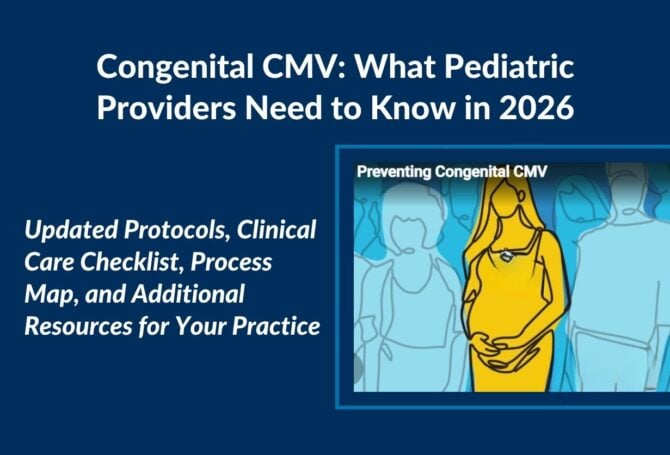
Congenital cytomegalovirus (cCMV) is the most common congenital infection in the United States, yet it is often under-recognized in everyday pediatric practice. June is National Cytomegalovirus Awareness Month, making this a great time to revisit what has recently changed in Oregon around screening and diagnosis, and what that means for how to manage care for these patients going forward.
The Clinical Picture
CMV is a common virus transmitted through close contact with bodily fluids, including saliva, mucus, urine, blood, breast milk, and semen. Most healthy people infected with CMV are asymptomatic or have mild, flu-like symptoms, which is part of why maternal infection so often goes undetected during pregnancy.
When a pregnant patient passes CMV to the fetus, the result is congenital CMV. Most babies born with cCMV grow and develop typically. Others go on to have long-term health issues including hearing loss, vision loss, developmental delays, and seizures, ranging from minor to severe and sometimes not appearing until later in childhood. Approximately 1 in 5 babies with cCMV infection will develop birth defects or other long-term health problems, such as hearing loss.
That 1-in-5 figure is the crux of why this matters clinically. cCMV-related hearing loss can be progressive or late-onset, meaning a newborn who passes their initial hearing screen can still develop hearing loss months or years later. A child’s CMV status, if known, directly informs how closely you monitor hearing and development over time, even when the newborn period was uneventful.
In Oregon, roughly 225 babies are born with cCMV each year–about one every other day.
What’s Changed: Universal Newborn Screening
Until recently, CMV screening and testing practices varied widely across Oregon—some facilities had processes in place, while others did not. Where testing did occur, it was typically limited to newborns who showed specific risk factors or clinical signs, meaning many cases went unidentified until a child later presented with hearing loss or developmental delay. That has shifted under Oregon Administrative Rules (OAR) 333-020-0125 through 333-020-0187, enacted via HB 2685 (2025).
As of April 1, 2026, all licensed hospitals and birthing centers in Oregon must conduct cCMV screening based on the Oregon Health Authority (OHA) Congenital Cytomegalovirus Screening Protocol. In practice, this means:
- Every newborn is assessed for known risk factors and clinical signs of cCMV prior to discharge or within 14 days of age, whichever comes first.
- If one or more risk factors or signs are present, the newborn undergoes CMV testing using a saliva swab or urine sample, with results typically returned in two to seven days.
- Testing must occur within the first 14 days of life, with diagnosis confirmed by 21 days, to ensure timely connection to care.
- Hospitals and birthing centers are required to directly notify both the parent/guardian and the newborn’s primary care provider of any positive result.
This builds on HB 2754 (2017), which first required OHA to distribute cCMV educational materials to hospitals, birthing centers, audiology facilities, and healthcare providers. The 2025 law expands that distribution to childcare facilities, the Department of Early Learning and Care, and prenatal providers, recognizing that awareness needs to start before birth.
OHA has published two protocols worth bookmarking for your practice: the cCMV Screening Protocol for hospitals and birthing centers, and the cCMV Diagnostic Testing and Care Protocol, which is specifically written for primary care providers managing a child after a positive diagnosis. A companion Clinical Care Checklist and process map are also available to help standardize follow-up.
Your Role After a Positive Result
When a newborn tests positive for cCMV, the diagnostic and care protocol calls for prompt follow-up to determine next steps, which may include additional testing, audiology and ophthalmology referrals, and developmental monitoring. Some infants will need antiviral therapy and early intervention referrals, both of which are most effective when started early, making timely follow-up after a positive screen a priority. It is highly recommended that all cCMV positive children be referred to early intervention services since they are eligible for services with a confirmed diagnosis.
Because hearing loss associated with cCMV can be progressive, ongoing surveillance matters well beyond the newborn period. Babies with congenital CMV need regular checkups to monitor for emerging problems as they grow, which makes primary care providers, not just audiology or infectious disease specialists, central to long-term monitoring. Any parent-reported concern about hearing or development in a child with a cCMV history warrants a closer look, even years after a normal newborn workup.
For patients who were not tested within the 21-day window but present later with concerns consistent with cCMV, there is a pathway to test using the existing newborn bloodspot card up to one year of age. This requires a completed Request for Specimen Transfer for CMV Testing form, signed by both parent and ordering provider, along with a copy of the parent or guardian’s government-issued ID, faxed to the Oregon State Public Health Laboratory.
Counseling Pregnant Patients
Pediatric providers aren’t always the ones counseling pregnant patients directly, but many providers see siblings, co-parents, or family members in our practices who are pregnant or planning to be. Pregnant people are often exposed to CMV through close contact with babies and young children, who may show only cold-like symptoms or none at all, and the risk to the fetus is highest with a new maternal infection during the first trimester.
Simple precautions meaningfully reduce risk and are worth reinforcing whenever the opportunity arises: frequent handwashing after contact with a young child’s saliva or urine, avoiding shared utensils or putting a child’s pacifier in one’s own mouth, kissing children on the head rather than the mouth during pregnancy, and routine disinfection of shared surfaces and toys.
Resources for Your Practice
OHA offers CMV prevention flyers and parent testing flyers in multiple languages, including English, Spanish, Russian, Korean, and several others, suitable for waiting rooms or to send home after a positive screen. You can also request printed copies of these handouts by using the links on the OHA cCMV webpage.
The American Academy of Pediatrics has compiled resources for healthcare providers, alongside separate materials for caregivers and families, that are well suited for both clinical reference and patient handouts. You can find the AAP’s cCMV resources here.
Additionally, you can access the following on-demand webinars that outline the new requirements and protocols.
- cCMV Screening Requirements for Hospitals and Birthing Centers Webinar, OHA and OPS Members, Dr. Sheevaun Khaki and Dr. Louise Vaz. The slides from this webinar can also be found here.
- cCMV Updates, Randall Children’s Hospital Grand Rounds
Why This Matters for OPS Members
Universal cCMV screening is a significant step forward for Oregon, but it shifts more responsibility onto primary care providers to manage what comes after a diagnosis: coordinating specialist referrals, tracking developmental milestones, and staying alert to delayed-onset hearing loss long after the newborn period has passed. This is a good time to review the new diagnostic and care protocol with your clinical team and make sure your practice has a clear workflow in place for handling a positive result.
For the full screening and diagnostic protocols, clinical checklists, and additional resources, visit the Oregon Health Authority’s CMV page. Have feedback to share? Send it to the OHA at Oregon.EHDI@odhsoha.oregon.gov.